
What Makes Customers Trust a Website? 8 Factors Businesses Often Overlook
- July 10, 2026
-
365admin2015
- Outsourcing
 5 mins read
Trust is rarely lost in one dramatic moment. It leaks away in small increments — a slightly inconsistent logo, a checkout page that feels a step behind the rest of the site, a claim with nothing to back it up.
Website trust signals influence how quickly visitors decide whether a business is credible. From secure browsing and customer reviews to professional design, transparent policies, and fast performance, these trust signals reassure visitors and encourage them to continue their journey with confidence.
Most businesses don't overlook these details because they don't care. They overlook them because building genuine trust online requires a mix of specialist skills — brand strategy, development, security, copywriting, marketing — that rarely all live inside one small team. That's precisely why so many growing businesses now treat branding, development, and marketing as work to hand to specialists rather than stretch an internal team to cover, the same way they'd outsource accounting or legal work rather than learn it from scratch.
Here are eight trust factors that quietly shape whether a visitor becomes a customer, and where outsourcing to the right specialists tends to close the gap faster than trying to fix it internally.
1. Why Website Trust Signals Matter for Business Growth: A brand identity that feels intentional, not improvised
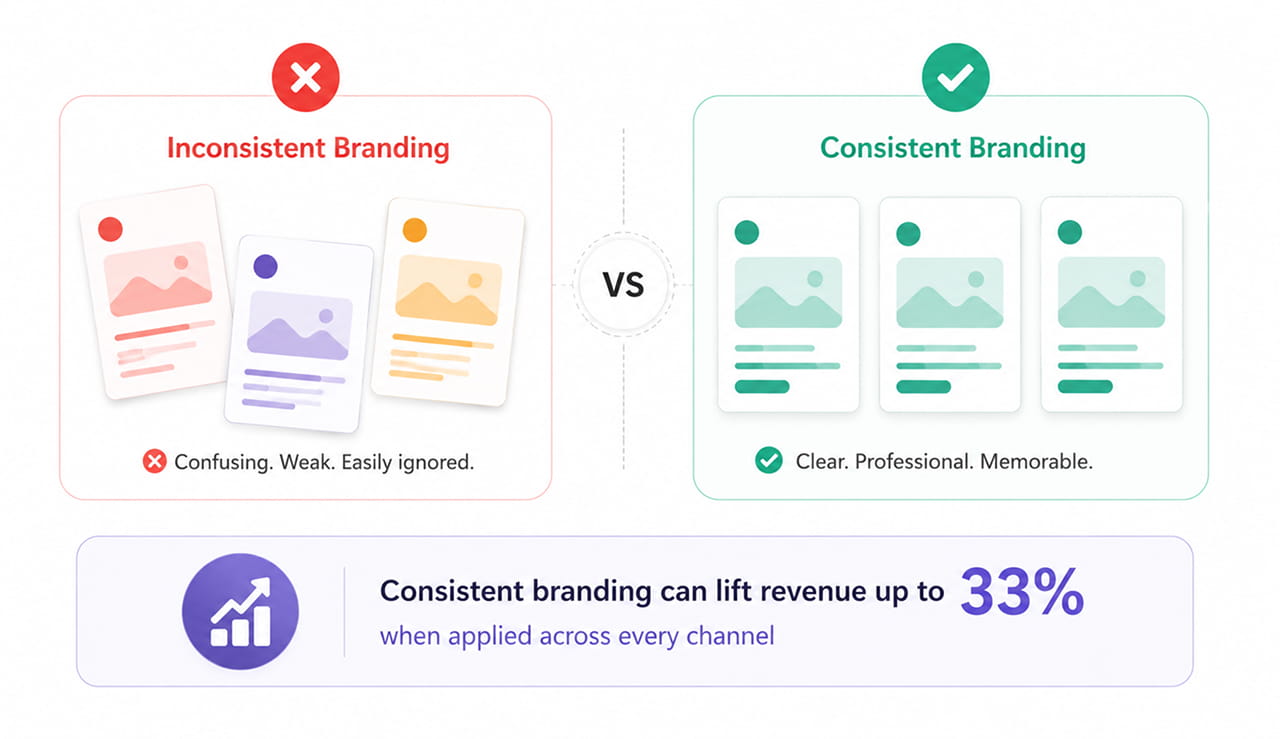
Visitors can tell within seconds whether a brand was carefully built or assembled in a hurry — mismatched fonts, a logo that looks slightly different across pages, colors that shift from the homepage to the contact form. None of these are catastrophic on their own, but together they read as "this business hasn't invested in itself," and that impression transfers directly onto how much a stranger is willing to trust the product or service behind it.
Brand identity work rarely gets the internal attention it deserves, because it sits outside most teams' core skill set. This is exactly the kind of work that benefits from outsourcing corporate branding and brand promotion to a team that builds brand systems for a living — one that can define a consistent visual identity once and apply it everywhere, instead of patching it together page by page.
2. Visual and message consistency across every channel
Trust compounds with repetition. A visitor who sees the same tone, colors, and promise on the website, in an email, and on social media starts to believe the business is stable and predictable. Lucidpress's State of Brand Consistency research, surveying more than 200 brand management professionals, found that consistent brand presentation across channels was linked to revenue increases of up to 33 percent.
Consistency breaks down fastest when different people manage different channels without a shared playbook — one person writing the website copy, another running ads, a third posting on social. Centralizing that work with a single outsourced partner is often the simplest fix, since one team working from one brand guide naturally stays aligned in a way that several disconnected freelancers rarely do.
3. Technical performance that doesn't undercut credibility
A beautifully designed site still loses trust if it loads slowly, breaks on mobile, or throws errors during checkout. Visitors don't separate "design problem" from "technical problem" — they just experience a site that feels unreliable, and unreliable feels untrustworthy.
Performance, security, and cross-device reliability are technical disciplines that change constantly, which is why outsourcing web development to a team that stays current with browsers, frameworks, and best practices tends to outperform an internal team that's stretched across unrelated priorities. A site built and maintained by specialists is far less likely to develop the small technical cracks that quietly erode visitor confidence.
4. Security cues visitors can actually see
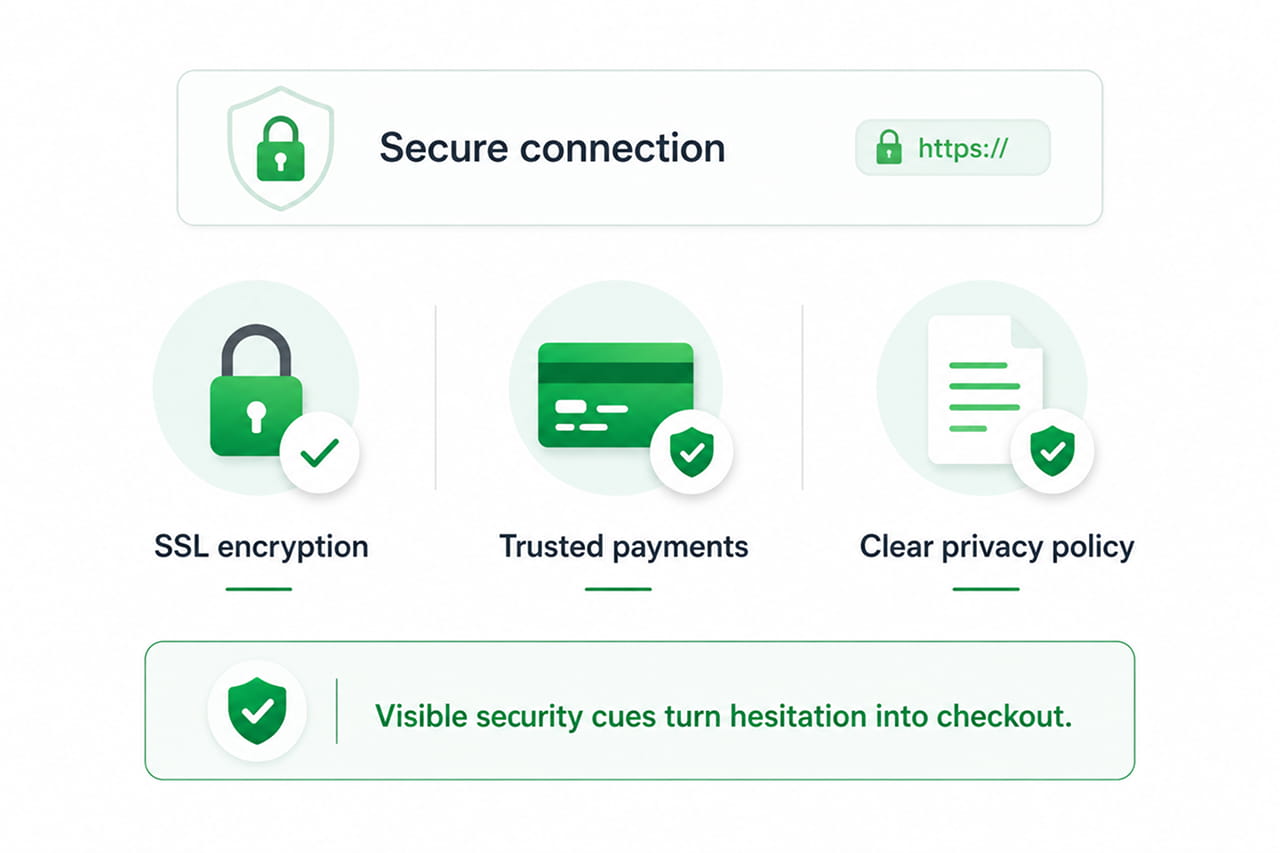
Most visitors can't evaluate a site's actual security, so they rely on visible shortcuts instead: a padlock icon, a recognizable payment logo, a clearly stated privacy policy, a professional-looking checkout flow. When those cues are missing or look outdated, visitors assume the worst even if the underlying infrastructure is perfectly sound.
This is another area where specialist development work pays for itself — proper SSL configuration, up-to-date payment integrations, and a checkout experience that looks and behaves the way visitors expect from a legitimate business.
5. Transparent, no-surprise pricing
Hidden fees, vague "contact us for pricing" pages, and costs that only appear at the final checkout step are among the fastest ways to lose a visitor's trust right at the point of decision. Even when the eventual price is fair, the feeling of being misled at the last step is enough to send a customer to a competitor instead.
Auditing pricing pages from a visitor's perspective, not the business's, usually reveals gaps that are easy to fix once they're visible: unclear tiers, missing details, or costs that should have been disclosed earlier in the journey.
6. Real proof: reviews, testimonials, and case studies
Claims about quality and expertise are easy to make and easy to doubt. Visible evidence — genuine reviews, named client examples, before-and-after results — does the convincing that marketing copy alone can't. A business that never gathers or displays this proof is asking strangers to take its word for it, which is a harder sell than most owners realize.
Collecting and presenting this proof well is its own skill: knowing which testimonials to feature, how to structure a case study, and where on the page that proof actually gets seen rather than scrolled past.
7. Professional, error-free content
Typos, broken links, outdated information, and awkward phrasing are small individually but damaging in aggregate. They signal that nobody is actively maintaining the site, and if nobody is maintaining the website, visitors reasonably wonder what else in the business might be neglected.
Content upkeep tends to fall through the cracks precisely because it feels like a small task — until it's been six months and the site still references a promotion that ended, a team member who's left, or a product that's been discontinued.
8. A cohesive experience from ad click to landing page
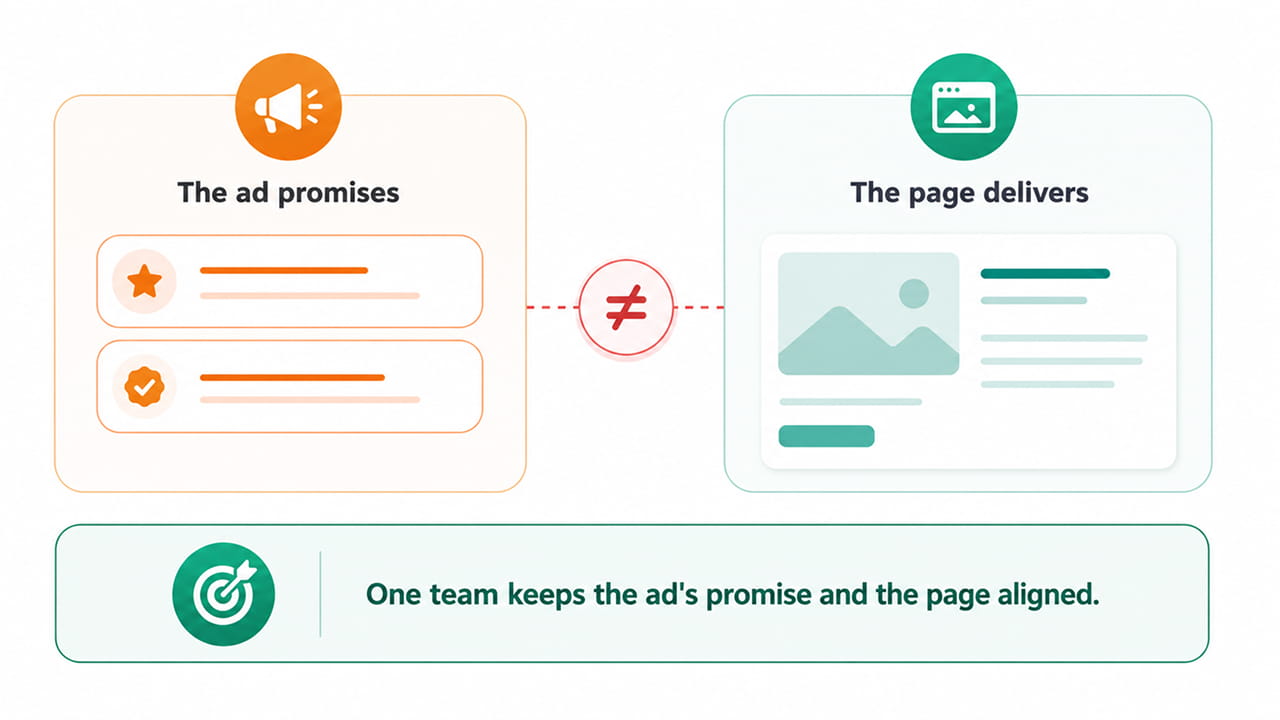
Trust doesn't start on the homepage. It starts the moment someone clicks an ad, a search result, or a social post — and if what they land on doesn't match what was promised, that mismatch registers as a small deception even when it was just poor coordination between teams.
This is where outsourcing online marketing services alongside branding and development makes the biggest difference: a single team managing the message from the ad through to the landing page keeps the promise and the delivery aligned, instead of leaving that handoff to chance between separate, uncoordinated vendors.
Why outsourcing closes these gaps faster than fixing them in-house
None of these eight factors are exotic. Individually, they're well understood. The real challenge is that trust is built at the intersection of branding, development, security, content, and marketing — and very few internal teams have deep expertise in all five at once.
Outsourcing isn't about handing off work a business doesn't want to do. It's about routing each piece of the trust equation to people who specialize in exactly that piece, so the brand looks intentional, the site performs reliably, and the marketing matches what visitors actually experience when they arrive.
Ready to see which of these eight factors your website is missing? Reach out through our contact form and we'll walk through your site together, and show you exactly where visitors are quietly losing trust before they ever reach out to you.
Outsourced365 Services are designed to help you grow
Contact us Today!
Why Companies Build Websites with Outsourced365
With our web design services, you will get:
- Modern, conversion-focused layouts
- Responsive design across all devices
- Optimized user experience and navigation
- Scalable websites built for growth

Related Posts
See all posts