

AI has moved from an experimental add-on to the operating layer of digital marketing in 2026. Adoption is now near-universal, budgets have shifted sharply toward AI tools, and the data shows measurable gains in speed, cost, and output — alongside real gaps in strategy and measurement.
AI in digital marketing is changing how businesses attract, engage, and convert customers. From AI-powered content creation and predictive analytics to marketing automation, personalized customer experiences, and smarter advertising campaigns, artificial intelligence helps businesses improve efficiency while delivering more relevant interactions.
If you'd rather have specialists apply these shifts to your own campaigns, outsourced365's digital marketing company team stays on top of exactly this kind of change so your strategy doesn't fall behind it. Here's what the numbers from Statista and other leading research sources say about the shift, and what it means for how marketing teams should be working this year.
What Is AI in Digital Marketing? Adoption Is Now the Default, Not the Exception
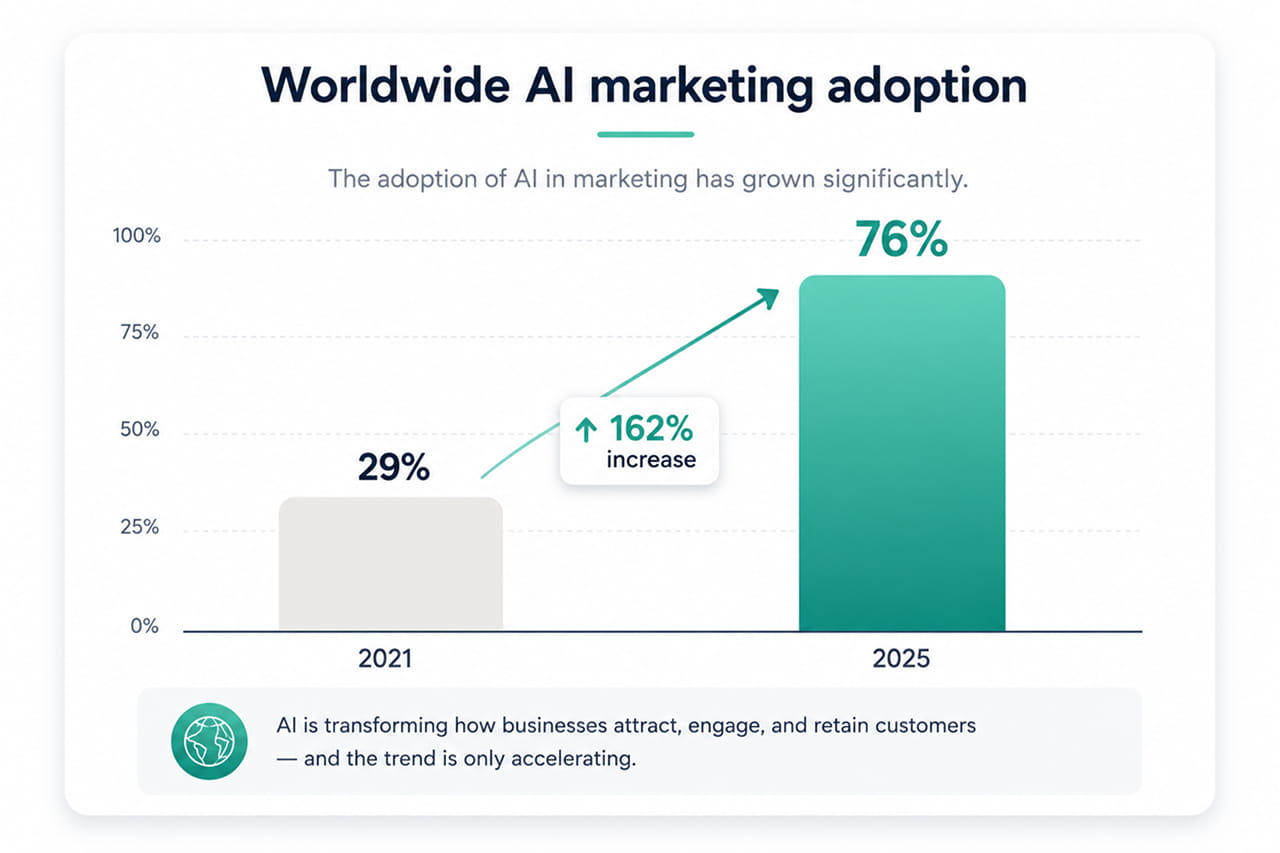
Marketing teams have crossed from early adoption into standard practice. Worldwide AI marketing adoption sits at 76% in 2026, up from just 29% in 2021, according to research compiled by BizIQ. That's a jump of well over 150% in five years, which puts AI adoption in marketing on a faster curve than most previous marketing technology shifts, including the early rise of marketing automation platforms.
By region, Statista's marketing AI data shows the United States leading individual-country adoption, with China and the United Kingdom following behind. Within marketing teams specifically, adoption is even higher: content marketers and SEO specialists report the highest internal usage rates of any marketing discipline, according to research from Digital Applied, while roles further from day-to-day content production, such as brand and event marketing, still lag behind.
This pattern suggests something important: AI adoption in marketing isn't evenly distributed. It's concentrated most heavily in the functions — content, SEO, demand generation — where output volume and iteration speed matter most, and it's still catching up in more strategic or brand-focused roles.
The Market Is Growing Fast
Statista's topic hub on generative AI in marketing tracks a market that's expanding quickly: global AI-in-marketing revenue is projected to climb well past $100 billion by 2028, roughly doubling from current levels within just two years. That trajectory is backed by real budget movement — mid-market marketing teams have nearly tripled their monthly AI tool spend within about a year, per BizIQ's 2026 analysis.
This isn't a story of hype outpacing reality; the spend increases are following real usage increases. Teams that added AI tools to their stack in 2025 largely kept spending on them into 2026 rather than pulling back, which is a meaningful signal about the perceived value marketers are getting from these tools in practice.
Where the ROI Is Coming From
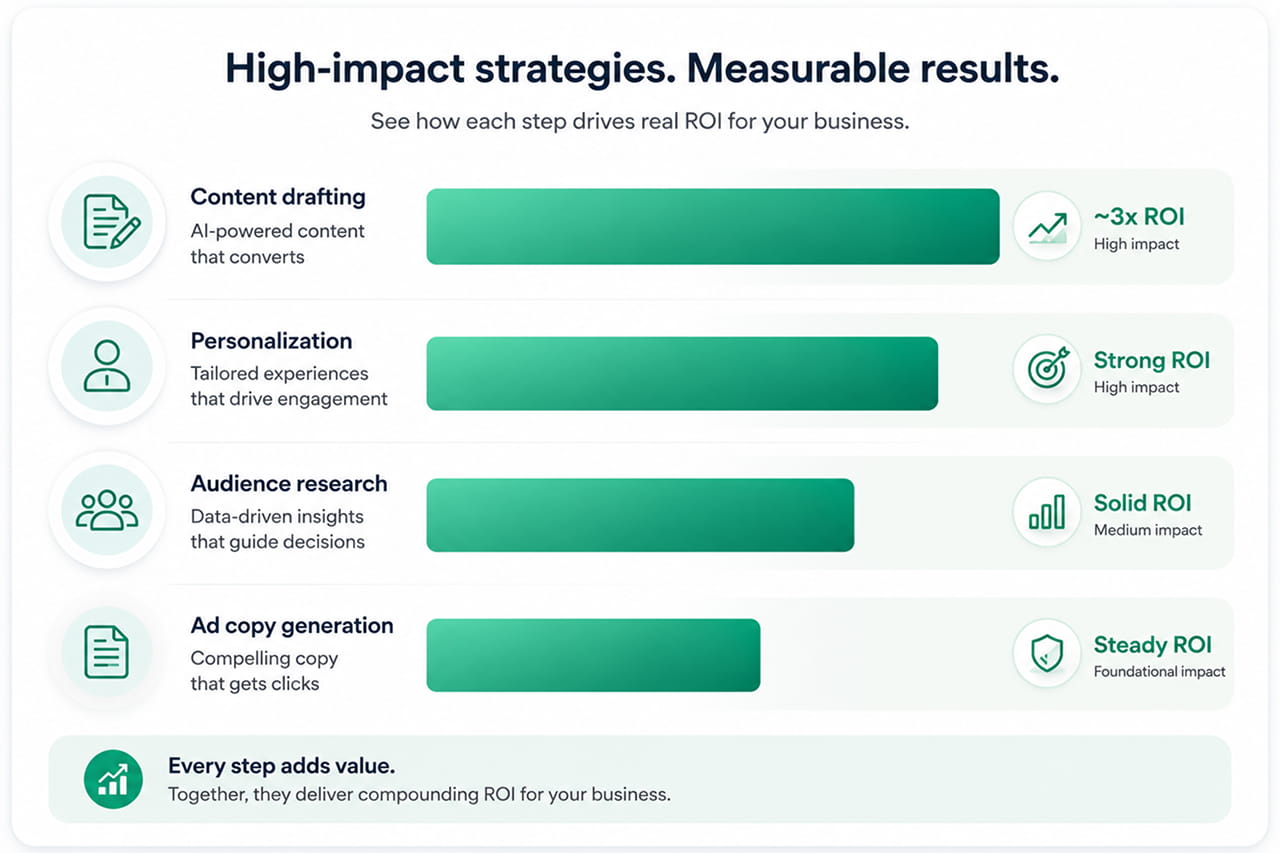
The clearest gains are showing up in content and personalization. Industry benchmarking compiled by Digital Applied points to AI-assisted content drafting delivering roughly 3x return on investment, with AI-driven personalization not far behind, followed by AI-assisted audience research and ad copy generation. These four use cases — content, personalization, research, and ad copy — currently represent the clearest, most consistently measured wins across the research.
Marketers are also recovering real time. HubSpot's 2026 trends data, cited across multiple industry reports, puts the average time saved at roughly six hours per week, with senior practitioners saving even more and junior staff seeing smaller but still meaningful gains. Over a full year, six hours a week works out to more than a week and a half of reclaimed working time per marketer — time that teams are largely reinvesting into strategy, testing, and campaign refinement rather than simply doing less work.
On the SEO side specifically, a majority of companies using AI-generated content report measurable improvements in search visibility, according to data referenced by the Digital Marketing Institute. That said, the relationship between AI content and SEO performance isn't automatic — it depends heavily on whether that content is edited, fact-checked, and genuinely useful rather than published at volume with minimal oversight.
Where AI Actually Shows Up in Marketing Work
It helps to step back from tool names for a moment and look at what AI is actually being asked to do. According to the Digital Marketing Institute, AI's role in marketing isn't confined to one job — it spans automating routine tasks, personalizing content for individual users, organizing and scoring leads, and analyzing or predicting customer behavior. Nearly every platform marketing teams have adopted in 2026 is really just a specific product built around one of those four jobs, which is why the tool landscape has gotten so wide so quickly: teams aren't adopting "an AI tool," they're adopting a different tool for each job.
The AI Marketing Platforms Teams Actually Use, By Function
Rather than one all-purpose AI tool, most marketing teams now run a small stack, with a different platform handling each part of the workflow.
Content & Copywriting
- ChatGPT — the most broadly used tool for drafting, research, and quick strategy work.
- Claude — favored for longer-form writing and editing where tone and accuracy matter more than raw speed.
- Jasper — built specifically for marketing teams that need brand-voice controls at scale, beyond what general-purpose tools offer.
SEO & Content Optimization
- Surfer SEO — optimizes drafts against what's actually ranking for a target keyword.
- Semrush — combines AI-assisted SEO, PPC, and competitor research in one platform.
- Frase — used to generate AI content briefs before writing even starts.
Social Media Management
- Hootsuite (OwlyWriter AI) — generates and schedules social captions and content at scale.
- Buffer AI — a lighter-weight option for scheduling and AI-assisted captions, popular with smaller teams.
Design & Video
- Canva Magic Studio — the default for fast, on-brand social graphics.
- Adobe Firefly — used for more polished, professional-grade creative work.
- HeyGen — generates AI spokesperson-style marketing videos without a camera crew.
Email, CRM & Automation
- HubSpot — the most widely adopted all-in-one platform, pairing AI with CRM, content, and campaign tools.
- Klaviyo — the standard for AI-driven email and SMS in e-commerce and DTC brands.
- Zapier — connects the rest of the stack together with AI-assisted workflow automation.
PPC & Advertising
- Google Ads (Performance Max) — AI-driven bidding and placement across Google's ad inventory.
- Meta Advantage+ — the AI layer behind most Facebook and Instagram ad campaigns today.
What a Typical Agency AI Stack Looks Like
In practice, most marketing teams and agencies aren't running every tool above — they're running one from each category, layered together. A common combination in 2026 looks something like: a general-purpose model such as ChatGPT or Claude for content and planning, Semrush for SEO and competitor research, Canva for graphics, HeyGen or a similar tool for video, HubSpot or Klaviyo for CRM and email, and Zapier for tying the workflow together. The specific brands vary by team, but the shape of the stack — one tool per job, not one tool for everything — has become the standard pattern
Content Volume Has Increased Sharply
One of the clearest behavioral changes in 2026 is sheer output. Multiple industry sources report that companies using AI tools are publishing significantly more content each month than they were before adoption, with content marketing showing the largest increase of any discipline. Production costs for that content have also dropped substantially across formats, from long-form articles to video scripts and social posts.
This creates an obvious tension worth naming directly: more content isn't automatically better content. The businesses seeing real results from this shift are generally the ones pairing higher output with stronger editorial standards, not the ones treating volume alone as a strategy.
The Gap: Everyone's Using AI, Few Are Measuring It Well
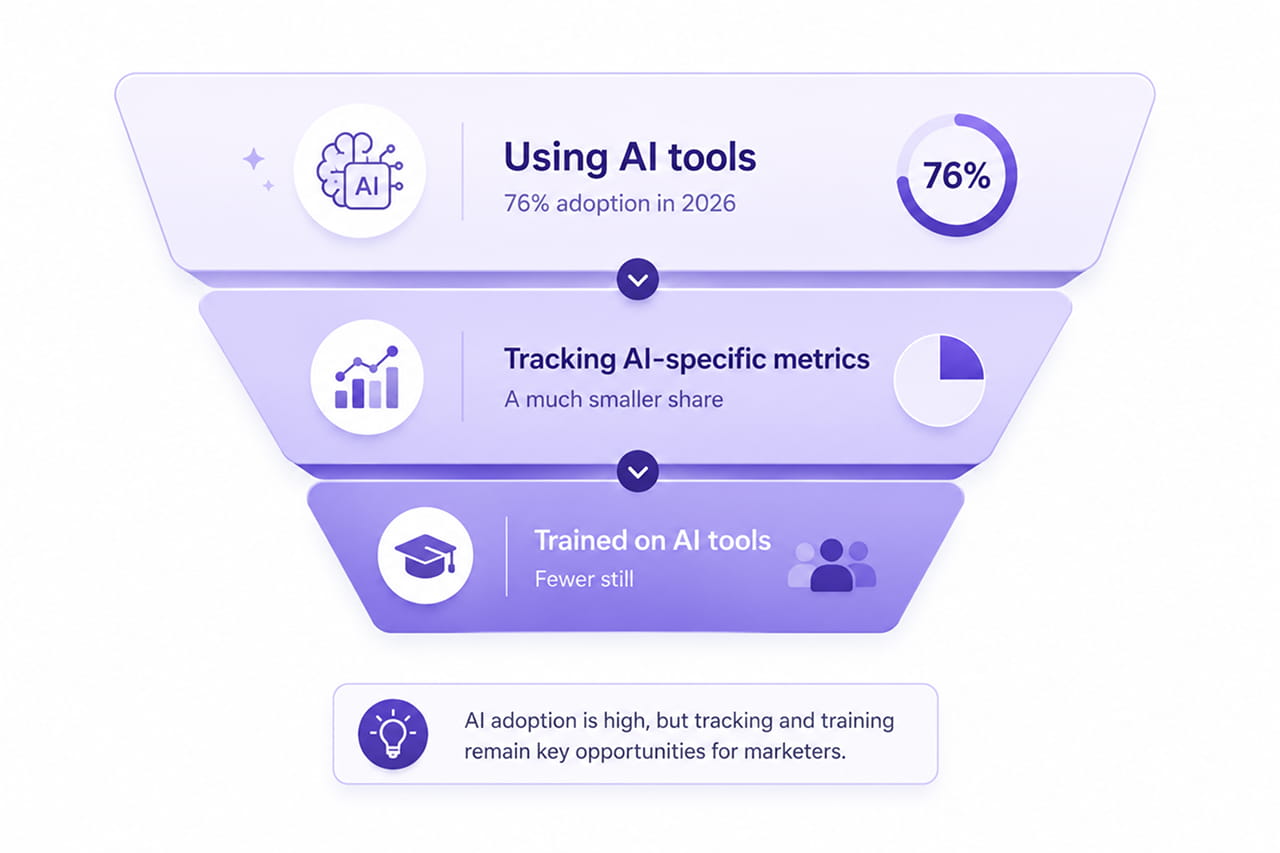
The most consistent finding across 2026 research isn't about adoption — it's about the gap between using AI and using it strategically. Multiple sources highlight that while AI usage is now close to universal, a much smaller share of marketers actually track AI-specific performance metrics, and fewer still have received structured training on how to use these tools effectively. Technology Checker's 2026 report frames this as the defining tension of the year: adoption has outpaced integration, and the marketers closing that gap first are the ones capturing the most durable advantage.
Skills gaps show up repeatedly as the top cited challenge, ahead of budget or technology limitations. That's a notable shift from a few years ago, when cost and tool availability were the more commonly cited barriers. In 2026, the bottleneck has moved from access to competence — most teams can get an AI tool; fewer know how to use it well enough to reliably beat their pre-AI results.
What This Means for Marketing Strategy in 2026
The practical takeaway from this year's data is fairly consistent across sources:
- AI is now table stakes, not a differentiator on its own — most competitors are already using it, so simply adopting a tool no longer confers much advantage by itself.
- The advantage has shifted to how AI is used. Teams pairing AI speed with real editorial and SEO strategy are outperforming teams simply publishing more content without a clear plan behind it.
- Measurement is the next frontier. Businesses that put structured KPIs and training behind their AI tools are seeing meaningfully better project outcomes than those treating AI as a plug-and-play add-on with no follow-up evaluation.
- Human oversight remains the differentiator on quality. The gains in speed and cost are real, but they depend on someone still reviewing, editing, and strategically directing the output rather than publishing it unchecked.
AI hasn't just sped up digital marketing in 2026 — it's reset the baseline for what "normal" marketing operations look like. Adoption numbers, market growth projections, and time-savings data all point in the same direction: AI is now deeply embedded in how marketing gets done. But the data is equally clear that strategy, measurement, and brand judgment are still what separate teams getting real business results from teams that have simply added a new tool to their workflow without changing how they think about growth.
LET'S TALK: PREPARE YOUR MARKETING FOR THE AI ERA
AI is changing digital marketing, but the businesses seeing the biggest gains are not the ones using the most AI tools. They're the ones using AI with a clear strategy, balancing automation with human expertise, and focusing on delivering better customer experiences instead of simply creating more content.
Success in 2026 comes from understanding where AI adds value, where human judgment still matters, and how both work together to improve marketing performance.
At Outsourced365, we help businesses adapt their digital marketing strategies for the AI-driven landscape. Our team helps businesses:
- integrate AI into content creation without sacrificing quality or brand voice
- optimize websites for both traditional search engines and AI-powered search experiences
- use AI to improve SEO, PPC, and social media performance through smarter data analysis
- automate repetitive marketing tasks while keeping human oversight where it matters
- build content strategies that earn trust, authority, and long-term visibility
- measure AI-driven marketing efforts with meaningful business metrics instead of vanity numbers
Whether you're just starting to explore AI or looking to refine an existing strategy, we help you use the technology in ways that support real business growth—not just follow the latest trend.
Ready to build a digital marketing strategy that works in the AI era? Contact us today, and let's create a practical roadmap that combines the power of AI with proven marketing expertise to help your business grow in 2026 and beyond.
Outsourced365 Services are designed to help you grow
Contact us Today!
Why Companies Build Websites with Outsourced365
With our web design services, you will get:
- Modern, conversion-focused layouts
- Responsive design across all devices
- Optimized user experience and navigation
- Scalable websites built for growth

Related Posts
See all posts