What CEOs Get Wrong About Outsourcing Website Development
- July 14, 2026
-
365admin2015
- Outsourcing
 5 mins read
Most CEOs formed their opinion of outsourcing years ago, usually around a specific bad experience or a secondhand story about one: a vendor who missed deadlines, a rebuild that cost more than starting over, a support ticket that vanished into a time zone nobody could reach during business hours.
Outsourcing website development allows businesses to access experienced developers, reduce operational costs, and accelerate project delivery. However, many CEOs focus only on price instead of selecting the right outsourcing partner, defining project requirements, and planning long-term website maintenance. Avoiding these common mistakes leads to better project outcomes and stronger business growth.
That opinion hasn't kept pace with how outsourcing actually works today. Deloitte's Global Outsourcing Survey found that 80 percent of executives are planning to maintain or increase their investment in third-party outsourcing — not because the risks disappeared, but because the model matured faster than most leadership assumptions about it did.
For website development specifically, the gap between what CEOs assume and what's actually true tends to show up in five recurring misconceptions.
Myth 1: "Why CEOs Choose Outsourcing Website Development: We're outsourcing mainly to cut costs"
This used to be true, and plenty of CEOs still frame the decision this way in the boardroom. But the data no longer backs that framing up.
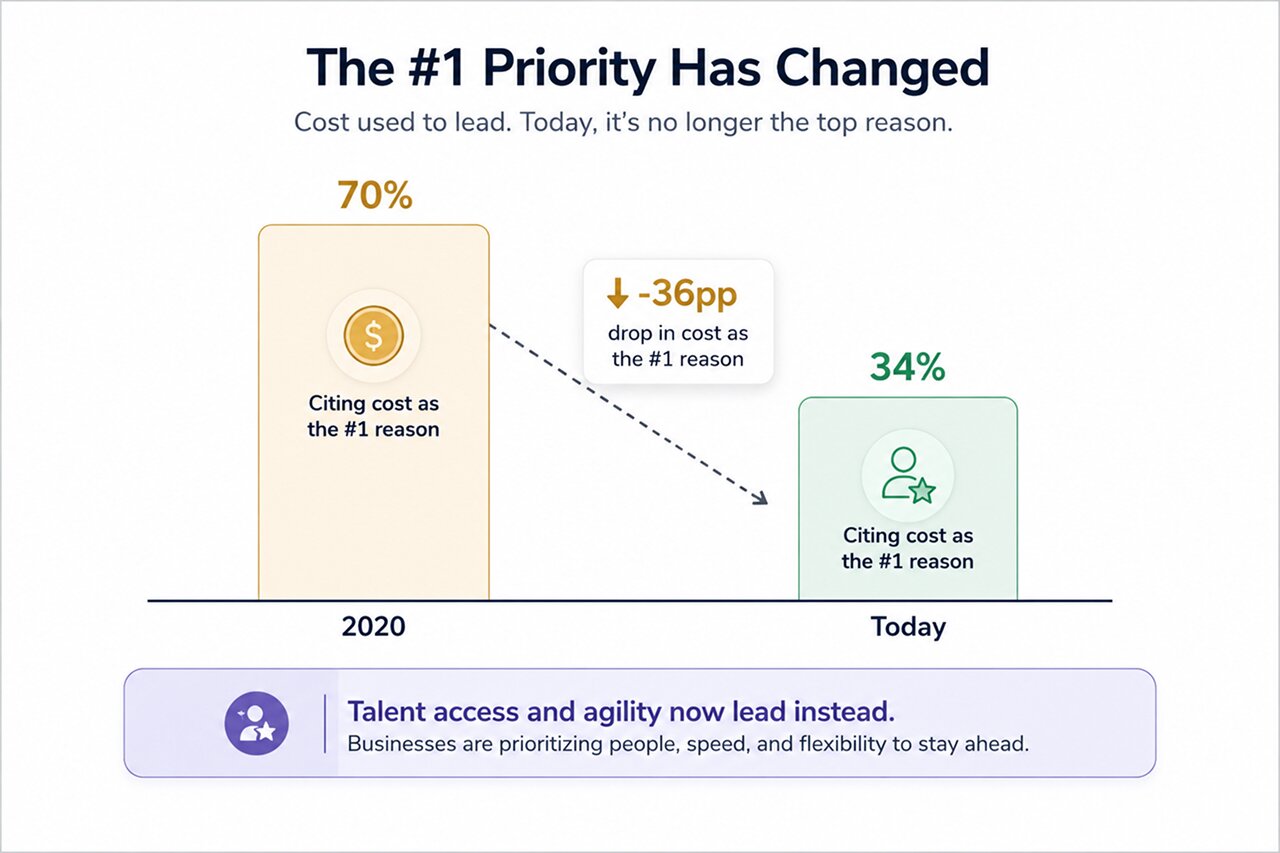
According to Deloitte's outsourcing research, cited in Auxis's analysis of 2026 IT outsourcing trends, only 34 percent of organizations now cite cost reduction as their primary reason for outsourcing, down sharply from 70 percent in 2020. Access to specialized talent and the ability to meet rising expectations have overtaken cost as the leading drivers.
That shift matters for how a CEO should evaluate a website development partner. Judging proposals mainly on the hourly rate optimizes for exactly the wrong thing. The businesses getting the most value from outsourced development are the ones asking whether the partner has skills their internal team simply doesn't — not which vendor is cheapest per hour.
Myth 2: "Outsourcing means losing control of the outcome"
This is the objection that kills the most outsourcing conversations before they start, and it's rooted in an outdated picture of how these engagements are run. The instinct is understandable — a website touches the brand, the data, the customer experience, and handing that to an outside team can feel like relinquishing oversight of something core to the business.
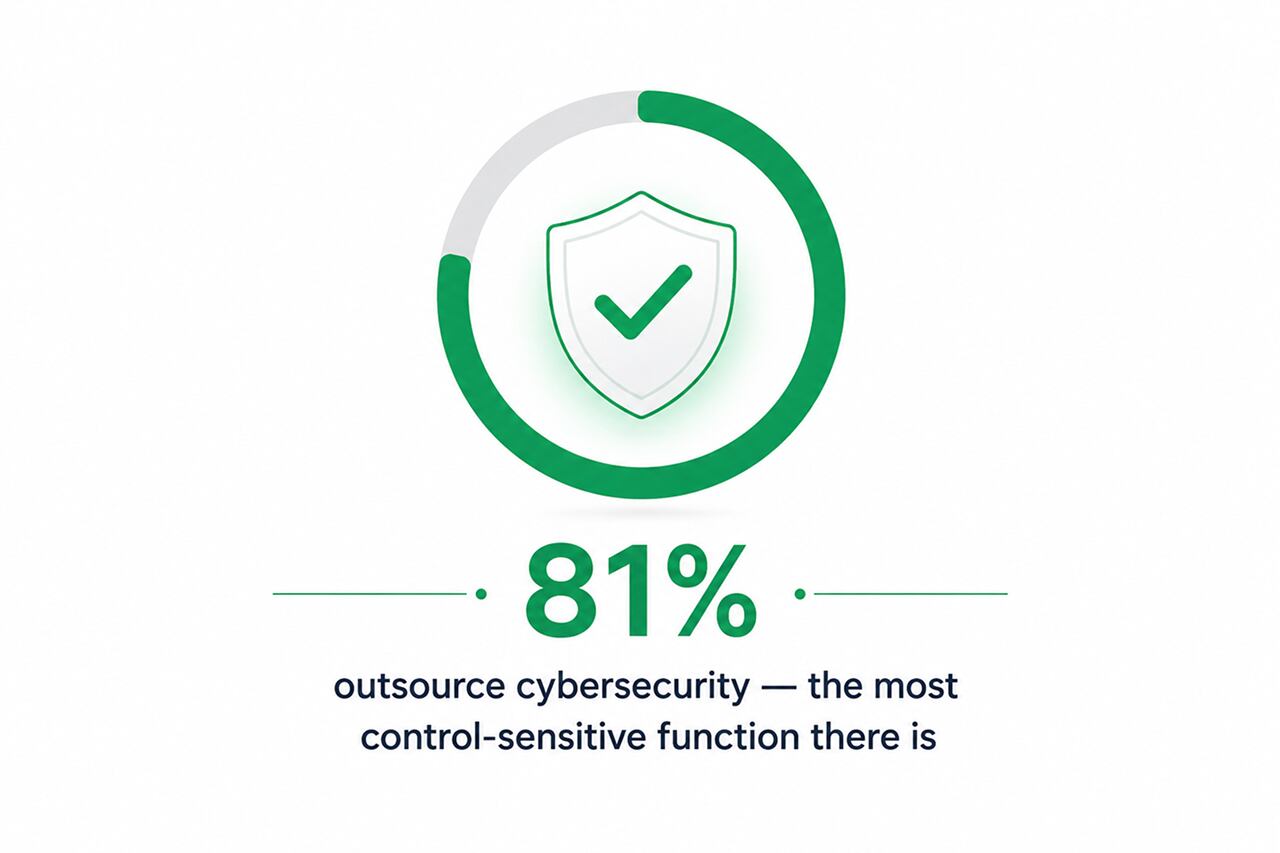
But look at what businesses are actually willing to hand off today. Deloitte's research, summarized in a recent roundup of outsourcing statistics, found that 81 percent of organizations now outsource at least some part of their cybersecurity function — arguably the single most control-sensitive area in any business, and far more consequential than a website redesign. If businesses are comfortable outsourcing cybersecurity with the right governance in place, "losing control" isn't really the risk. The real variable is whether proper oversight, reporting, and approval checkpoints were built into the engagement.
Myth 3: "The cheapest proposal is the safest financial decision"
CEOs who would never accept the lowest bid on a piece of manufacturing equipment or a legal contract often apply exactly that logic to a website RFP. The reasoning is usually that a website is "just design and code," so the outcome should be roughly comparable regardless of who builds it.
That reasoning doesn't hold up in practice. A bare-minimum quote almost always means a bare-minimum scope: no discovery phase, no performance or security testing, no plan for what happens after launch. The lowest number on a proposal isn't a discount — it's usually a preview of what's been left out, and those omissions tend to resurface as unplanned costs well after the invoice has been paid and the CEO has moved on to the next priority.
Myth 4: "The project ends at handover"
Many CEOs still mentally file website development under "one-time project" rather than "ongoing capability," which shapes how the vendor relationship gets structured from day one — a fixed-scope contract, a launch date, and an assumption that the relationship winds down once the site goes live.
That framing is increasingly out of step with how outsourcing relationships are actually being run elsewhere in the business. Across functions, companies are shifting toward outcome-based delivery models and treating providers as ongoing strategic partners rather than one-off vendors, precisely because the work that matters most — performance, security, conversion, search visibility — is never really finished at launch. A website evaluated only against a launch-day checklist will start losing ground to competitors within months, regardless of how well it was built on day one.
Myth 5: "Our in-house team will always be faster and more accountable"
This one is rarely stated so bluntly, but it sits underneath a lot of outsourcing hesitation: the belief that a website managed internally will move faster because there's no external coordination overhead, and stay more accountable because everyone involved reports to the same CEO.
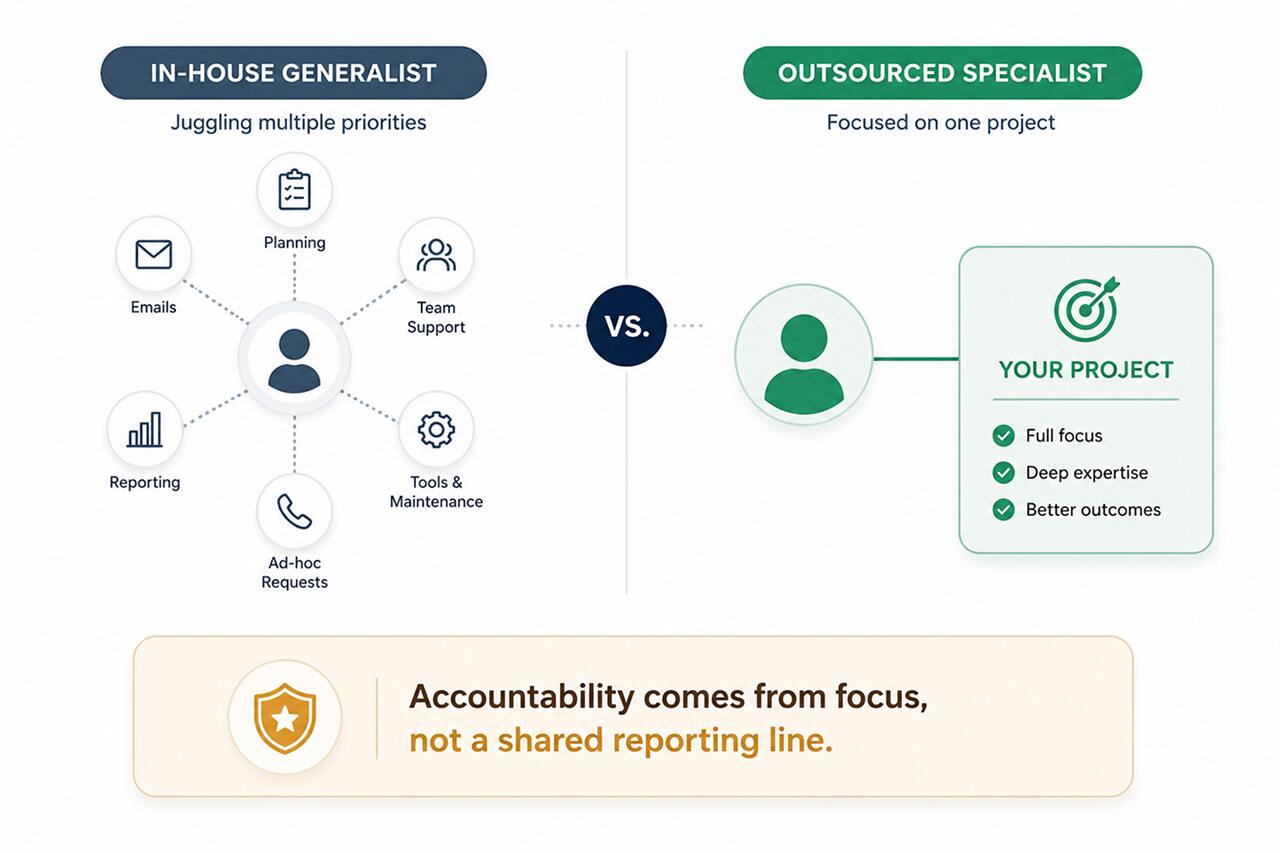
In practice, the opposite is often true for specialized work like web development. A generalist internal team stretched across other priorities frequently moves slower on a website project than a specialist partner whose only job that week is exactly that project. Accountability doesn't come from an internal reporting line — it comes from clear deliverables, defined timelines, and someone whose role is explicitly to answer for the outcome. A well-structured outsourcing agreement can build in more accountability than an internal team juggling the project alongside five unrelated priorities, not less.
The Real Question Isn't Whether to Outsource
None of this means outsourcing is automatically the right call, or that every vendor deserves that level of trust. The businesses getting real value from outsourced website development aren't the ones who outsourced blindly — they're the ones who replaced outdated assumptions about cost, control, and accountability with a clear-eyed look at what actually drives good outcomes: the right expertise, the right governance, and a relationship built to last well past launch day.
LET'S TALK: OUTSOURCE YOUR WEBSITE DEVELOPMENT THE RIGHT WAY
The outsourcing decisions that go wrong usually aren't wrong because outsourcing itself was the mistake — they're wrong because they were built on assumptions that stopped being true years ago. Judging proposals on price alone, treating a launch date as the finish line, or assuming an internal team will always be faster are all reasonable instincts that no longer match how outsourcing actually performs when it's done well.
Getting it right starts with replacing those assumptions with the right structure: clear governance, defined accountability, and a partner treated as an extension of the team rather than a one-time vendor.
At Outsourced365, we help businesses across the US, UK, and Europe build and manage website development partnerships that hold up to exactly this kind of scrutiny. Our services are designed to help businesses:
- access specialized web development talent without expanding internal headcount
- maintain full visibility and control through clear reporting and approval checkpoints
- avoid the hidden costs of underscoped, bare-minimum builds
- structure engagements around outcomes, not just fixed-scope handovers
- keep security, performance, and SEO governed long after launch day
- scale website support up or down as business needs change
From scoping and governance to ongoing web development and post-launch support, our team helps CEOs build outsourcing relationships that deliver on what the data actually shows works — not what outdated assumptions still assume.
Ready to see what a well-governed outsourcing partnership could look like for your website? Reach out through our contact form and we'll get back to you promptly. Let's replace the guesswork with a clear plan for how outsourced website development can support your long-term growth.
Outsourced365 Services are designed to help you grow
Contact us Today!
Why Companies Build Websites with Outsourced365
With our web design services, you will get:
- Modern, conversion-focused layouts
- Responsive design across all devices
- Optimized user experience and navigation
- Scalable websites built for growth

Related Posts
See all posts